How to Enhance Lab Efficiency with Slide Printing?
Table of Content
[Hide]
Regardless of laboratory size, whether clinical or research laboratories, efficiency is crucial. It directly affects the integrity of diagnostic results and scientific verification. To improve efficiency, the first step is to reduce human errors, and one of the most effective ways to reduce human errors is to abandon the outdated practice of manually labeling slides. In this article, we explore how laser slide printing works, how modern systems improve laboratory efficiency, and how Jinquan’s slide printer solutions are evolving to meet the needs of contemporary histology laboratories.
Principles and Core Advantages of Laser Slide Printing Technology
Laser slide printing technology uses a focused ultraviolet (UV) laser to etch permanent, high-resolution marks directly onto microscope slides. Unlike traditional thermal transfer or inkjet methods, UV laser systems create crisp 1D and 2D barcodes, alphanumeric text, graphics, and symbols without ink, ribbons, or adhesive labels. The result is a print that withstands exposure to formalin, xylene, alcohol, and other histology chemicals while maintaining scannability for LIS integration and digital pathology workflows.
Core advantages include exceptional resolution—far surpassing inkjet or thermal transfer printers—along with zero consumables, which eliminates ongoing costs and downtime for label replacement. Prints are permanent and non-smearing, ensuring traceability throughout staining, coverslipping, and archiving. In high-volume histopathology settings, this direct-to-glass process supports both on-demand single-slide printing and batch production, giving technicians flexibility without interrupting microtomy or staining stations.
How Modern Slide Printers Improve Laboratory Efficiency?
Modern slide printers integrate directly with laboratory information systems (LIS) to automate label generation based on accession data, specimen type, and staining protocols. On-demand modes allow a technician to load a slide and print in seconds by simply pressing a button, while batch modes handle larger runs without manual intervention. This eliminates the multi-step process of handwriting labels, selecting pre-printed slides, or applying adhesive tags—steps that traditionally add seconds per slide and introduce transcription errors.
Time savings are immediate: automated systems can generate labels in 3–5 seconds, and LIS-driven printing removes separate data entry. A study referenced in pathology automation discussions showed on-demand printing reduced slide identification errors by up to 95% compared with batch methods. Laboratories report fewer misidentification incidents, faster case turnaround, and reduced rework, allowing staff to focus on high-value tasks such as sectioning and quality review rather than label management.
Advancements in Jinquan Slide Printers for Histology Laboratory
Jinquan Medical has developed a comprehensive range of slide printing solutions designed to meet diverse laboratory needs, from small clinics to large pathology centers.
Laser Slide Printer Solutions
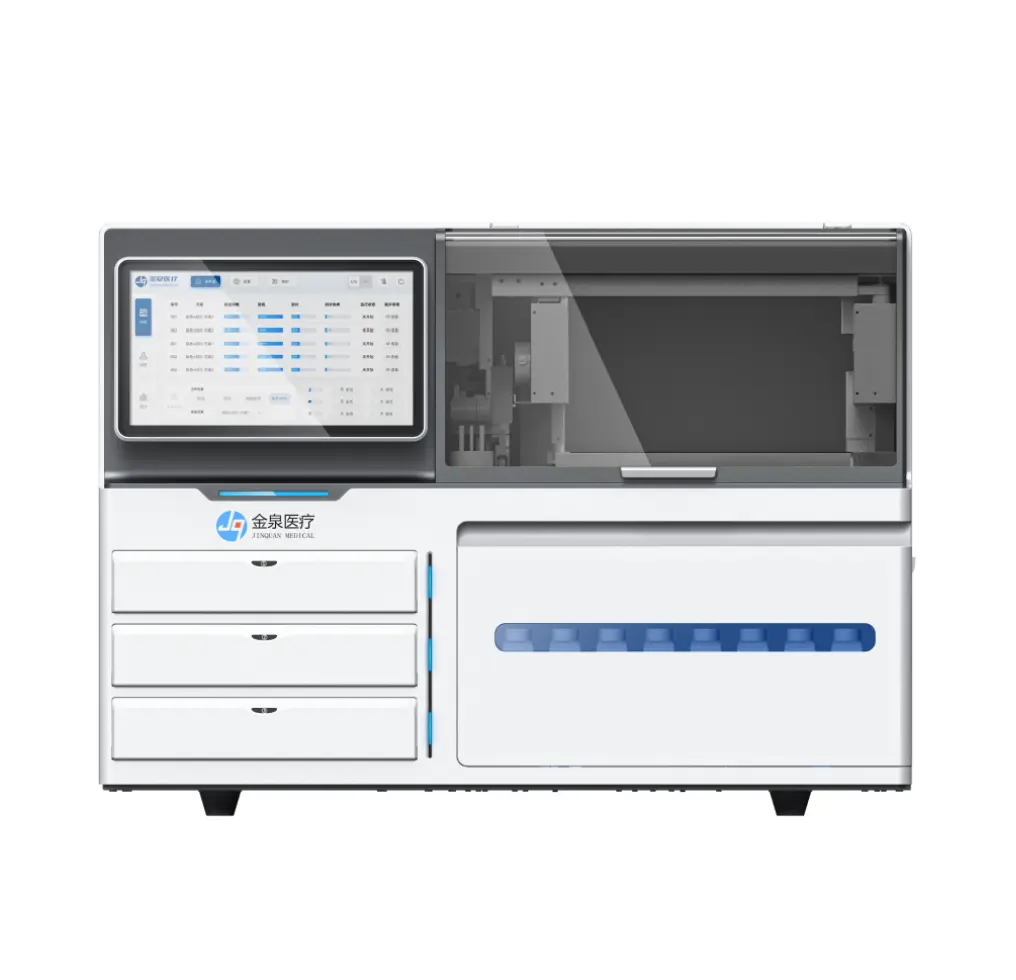
Jinquan’s laser slide printers are designed to deliver permanent, high-contrast markings suitable for demanding histology environments. By leveraging laser technology, these systems ensure durability and eliminate the need for consumables, aligning with cost-efficiency goals.
On-Demand Printing Systems
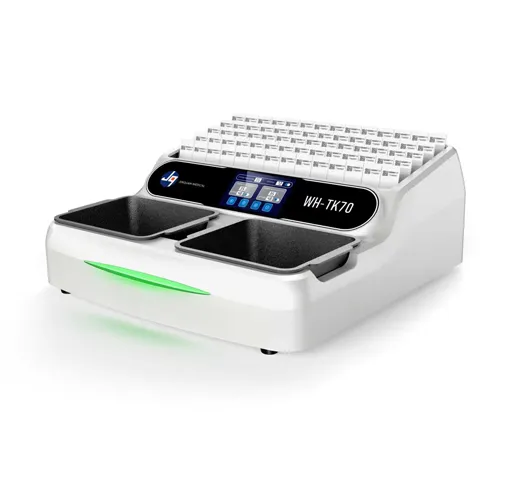
For laboratories that require flexibility and rapid turnaround, Jinquan offers on-demand slide printers capable of immediate printing based on real-time LIS data. These systems are particularly valuable in clinical settings where urgent cases must be processed without delay.
Batch Printing Systems
High-volume laboratories benefit from Jinquan’s batch printing solutions, which are engineered for continuous operation and large-scale slide production. These systems optimize throughput while maintaining consistent print quality.
Intelligent Workflow Design
A key feature across Jinquan’s product line is intelligent slide management. Automated slide loading, multi-slot design, and precise control systems help streamline operations and reduce manual handling. This aligns with modern laboratory demands for automation and standardization. By focusing on reliability, integration, and user-centric design, Jinquan’s slide printers support laboratories in achieving higher efficiency without compromising quality or compliance.
Conclusion
As laboratories continue to face increasing workloads and stricter quality requirements, improving efficiency is no longer optional—it is essential. Slide printing, once considered a minor step in the workflow, has become a critical control point for accuracy and productivity.
With advanced solutions such as laser, on-demand, and batch slide printers, Jinquan Medical empowers laboratories to transition from manual processes to intelligent, automated workflows. Contact us to explore the complete Jinquan laser slide printer range and discover how your laboratory can achieve greater efficiency, accuracy, and workflow consistency.
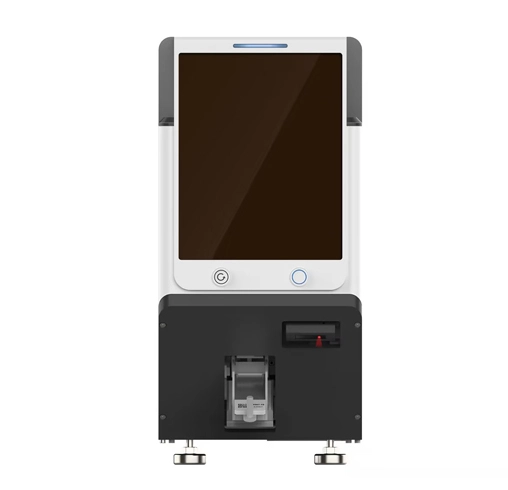
(1)_20260113172827.webp "JQ-GM6210P On-Demand Slide Printer")