Histology Grossing Station: The Complete 2026 Guide for Pathology Laboratories
Table of Content
[Hide]
In today's high-volume pathology environments, the histology grossing station remains the foundational piece of equipment that directly influences diagnostic accuracy, technician safety, and laboratory compliance. As pathology workflows face increasing demands for precision, traceability, and biohazard control, selecting the right grossing station is no longer optional—it is a strategic investment.
What is a Histology Grossing Station?
A histology grossing station, also known as a pathology grossing workstation or tissue grossing bench, is a specialized, ventilated work surface designed for the macroscopic examination, dissection, and initial preparation of surgical and biopsy specimens. It serves as the very first controlled step in the histopathology workflow—before fixation, embedding, sectioning, or staining.
During grossing, pathologists or trained technicians measure, describe, ink, and section tissue samples to ensure proper orientation and representative sampling for downstream microscopic analysis. Any error at this stage—such as uneven slicing, loss of anatomical landmarks, or cross-contamination—can compromise the entire diagnostic chain.
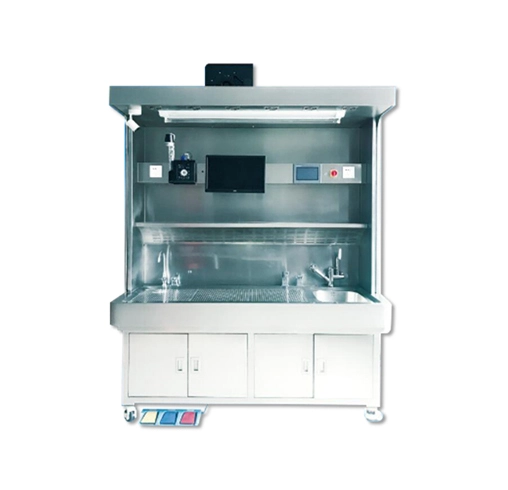
Modern grossing stations integrate several core functions:· Precise tissue dissection with standardized cutting surfaces· Immediate rinsing and fluid containment to prevent spills· Real-time specimen labeling and photography areas· Built-in safety systems for handling formalin-fixed or infectious tissuesIndustry sources consistently emphasize that effective grossing stations must provide both operator protection and specimen integrity. For example, laboratory safety protocols highlight the need for localized exhaust ventilation to capture chemical vapors at the source, aligning with broader CAP and OSHA requirements for hazardous chemical handling in anatomic pathology.
In high-throughput settings—hospitals, reference labs, and research institutions—the grossing station transforms what was once a basic dissection table into a controlled, ergonomic workstation that supports compliance with international standards such as ISO 15189 and CAP Laboratory Accreditation Program checklists.
Key Features of a High-Performance Grossing Station
High-performance histology grossing stations go far beyond a simple stainless-steel bench. They incorporate engineering that addresses three simultaneous priorities: specimen quality, operator safety, and workflow efficiency.
Advanced Ventilation Systems
The cornerstone feature is a dual-draft or down-draft ventilation design. These systems pull harmful vapors (formaldehyde, xylene) downward or backward through strategically placed intakes directly at the work surface. Many premium models add a vertical fresh-air supply that creates an invisible “air curtain,” directing clean filtered air toward the operator while pushing contaminants away. Secondary filtration—often using chemical media and negative-ion technology—further neutralizes residual gases before exhaust. Such configurations dramatically reduce airborne exposure compared with older back-draft-only units.
Ergonomic and Smart Controls
Adjustable or ergonomically optimized work heights, pedal-controlled water systems, and integrated high-resolution touch-screen interfaces allow single-operator control of lighting, ventilation, and documentation without breaking sterile flow. LED shadowless lighting, magnetic tool holders, and large integrated sinks with mixing faucets and filters minimize fatigue during long grossing sessions.
Safety and Containment Enhancements
Safety splash shields (glass or polycarbonate), emergency eyewash integration, and optional formalin monitoring systems protect personnel handling biohazardous or chemically preserved tissues. Removable perforated work surfaces and seamless construction enable rapid decontamination between cases.
Material Durability and Cleanability
Medical-grade stainless steel with integrated, inward-sloped edges prevents liquid pooling and simplifies disinfection. These features collectively deliver higher throughput, lower contamination risk, and documented compliance with occupational health standards.
304 Stainless Steel Grossing Station vs Ordinary Countertops
| Feature | 304 Stainless Steel (Grossing Station) | Epoxy Resin | High-Pressure Laminate (HPL) | Basic Aluminum |
|---|---|---|---|---|
| Corrosion & Chemical Resistance | Excellent vs formalin, disinfectants, alcohols; good overall (316 better for chlorides) | Superior vs harsh acids, bases, solvents | Poor-moderate; degrades/absorbs chemicals | Variable; prone to corrosion |
| Hygiene & Cleanability | Completely non-porous; quick sterilization; no microbial harbor | Non-porous; excellent cleanability | Develops scratches/seams; harbors bacteria | Can scratch/dent; contamination risk |
| Durability & Longevity | 15–20+ years; withstands daily heavy use & disinfection | 10–20 years; very durable | 5–10 years; wears quickly in pathology settings | Shorter; dents easily |
| Integration (Ventilation/Sinks) | Seamless built-in ducts, sinks, edges; meets CAP/OSHA out-of-box | Possible but less common for grossing features | Difficult; poor fume/splash containment | Limited; hard to integrate |
| Best For | Histology grossing, sterile/biohazard labs | Harsh chemical/wet labs (non-biological focus) | Light-duty/educational labs | General non-specialized use |
| Long-Term Cost | Higher upfront → lower overall (fewer replacements, easier audits) | Moderate-high; strong in chemical-heavy settings | Lowest upfront → higher due to frequent issues | Variable; often higher indirect costs |
How Jinquan Medical Grossing Stations Deliver Competitive Advantage?
Jinquan Medical designs its pathology grossing stations specifically for modern histopathology demands, combining proven 304/316 stainless-steel construction with intelligent ventilation and user-centric controls.
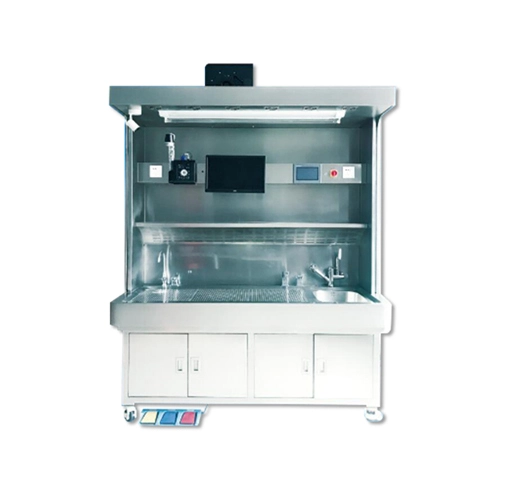
The JQ-PS150 model (1500 × 760 × 2100 mm) and JQ-PS180 model (1800 × 760 × 2175 mm) both feature national-standard stainless steel—304 on the PS150 and upgraded 316 on the PS180 for enhanced chemical resistance. Each workstation incorporates an integrated workbench top with a 60 mm inward lower edge and glass baffles to contain splashes completely.
Ventilation performance is a standout: a high-end double-channel exhaust system with 10 precision air intakes (positioned on the inner side of the work surface) directly captures and discharges harmful gases to the external duct.
Operational intelligence comes from a built-in 10-inch high-resolution color touch-screen control system that lets technicians monitor and adjust every functional zone—ventilation, lighting, and water flow—without leaving the sterile field.
Key Considerations for Purchasing and Installing a Grossing Station
Choosing and installing the right histology grossing station requires systematic evaluation.
Step 1 – Assess Laboratory Needs
Calculate daily specimen volume, types of tissue (standard soft tissue vs. bony or infectious cases), and available space. Single-station labs often start with the 1500 mm model; higher-throughput departments benefit from the wider 1800 mm platform.
Step 2 – Prioritize Ventilation and Compliance
Verify that the unit offers down-draft or dual-draft exhaust with external duct connection capability. Confirm secondary filtration for formaldehyde and compatibility with your building’s HVAC system. Request documentation showing alignment with OSHA permissible exposure limits and CAP checklist items for chemical hygiene.
Step 3 – Evaluate Ergonomics and Controls
Ensure adjustable or optimized height, touch-screen interface, and pedal water control to reduce repetitive-strain injuries. Test the placement of sinks, lighting, and documentation areas during a factory or showroom demo.
Step 4 – Material and Accessory Checklist
Insist on medical-grade 304 or 316 stainless steel with seamless construction. Confirm included features such as glass splash shields, large filtered sinks, and optional formalin monitoring or imaging systems. Request a full spare-parts and filter-replacement schedule.
Step 5 – Installation Best Practices
· Engage the manufacturer for a site survey to confirm duct sizing, electrical requirements (typically 220 V), and floor load capacity.
· Schedule professional installation to align exhaust ducts and calibrate fresh-air supply.
· Plan for post-installation airflow testing and staff training on touch-screen operation and daily decontamination protocols.
· Budget for annual HEPA-style or chemical filter changes and periodic certification of containment performance.
At Jinquan Medical, we specialize in manufacturing high-end pathology equipment tailored to international standards. Whether you need a standard JQ-series station or a custom-configured suite, our engineers are ready to assist.
Contact our Technical Sales Team for a Detailed Quote.